
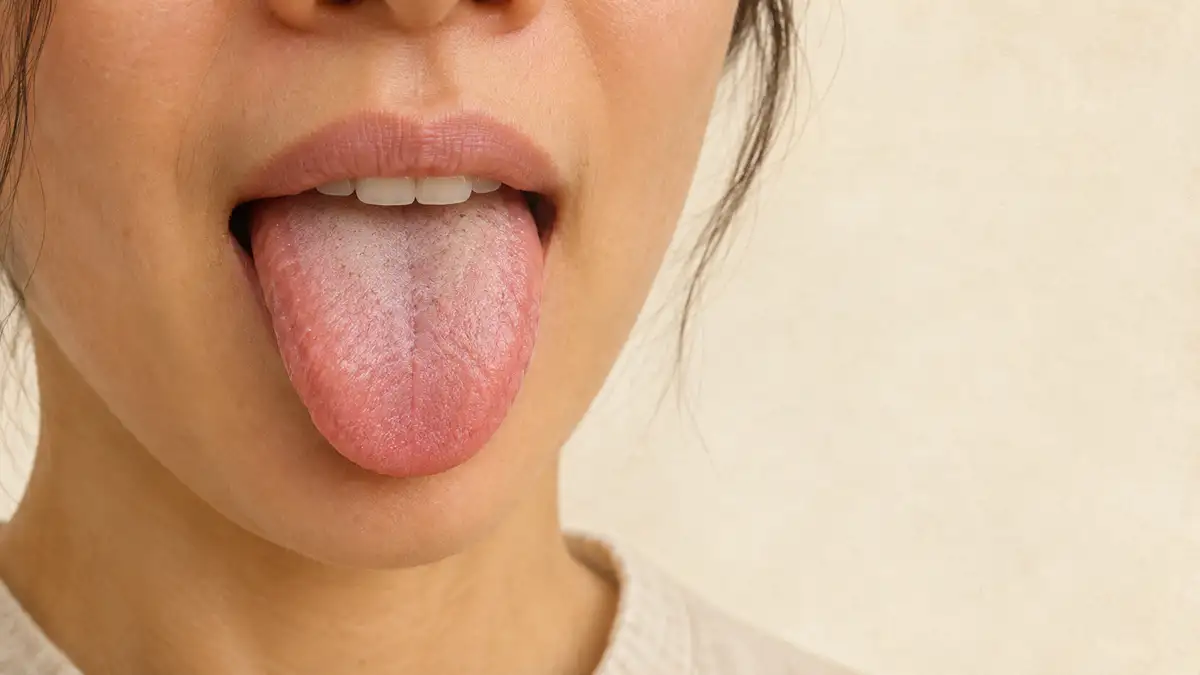
You sit down for an acupuncture appointment, answer a long list of questions, and then your acupuncturist asks you to stick out your tongue. It can feel surprisingly personal, and it is reasonable to wonder what they are actually looking for.
In Chinese medicine, the tongue is one part of the examination. Its color, coating, moisture, shape, and movement can add context to what you have already described. It is not a crystal ball, an organ scan, or a stand-alone diagnostic test. I use it the same way I use the pulse, palpation, medical history, and symptom pattern: as one clue that may support or challenge the working picture.
Key takeaways
- Acupuncturists traditionally observe the tongue body, coating, moisture, shape, cracks, and movement.
- A tongue finding only has meaning in context. Food coloring, coffee, dehydration, mouth breathing, medications, smoking, illness, and oral hygiene can temporarily change its appearance.
- Traditional tongue regions are part of a Chinese medicine pattern system. They are not a literal anatomical map of the internal organs.
- Research on tongue diagnosis is still limited by subjectivity, variable terminology, lighting, and inconsistent agreement between practitioners.
- Tongue inspection should never replace a dental or medical examination for a persistent sore, lump, red or white patch, bleeding, numbness, or difficulty swallowing.
What an acupuncturist is actually looking at
The tongue is visible tissue with a rich blood supply, a moist surface, muscle tone, and a coating influenced by saliva, bacteria, food debris, and oral health. That makes it responsive to many ordinary changes in the body and environment.
Traditional Chinese medicine developed a structured way of describing those observations. A practitioner may look at:
- Body color: pale, pink, red, dark red, or purplish.
- Coating: thin or thick, white or yellow, patchy, greasy, or absent.
- Moisture: unusually dry, normally moist, or very wet.
- Shape: swollen, thin, scalloped, stiff, trembling, or deviated.
- Surface: cracks, spots, peeled areas, or changes in texture.
- Movement: whether the tongue extends comfortably and remains centered.
These are descriptive findings, not diagnoses by themselves. A pale tongue does not automatically mean anemia. A red tongue does not prove inflammation. A thick coating does not identify one particular digestive disorder. The finding matters only after it is compared with the rest of the case.
How tongue findings are interpreted in Chinese medicine
Traditional interpretation asks what pattern best explains several findings together. A pale, enlarged tongue with a wet coating may be considered differently from a pale, thin, dry tongue. Both are “pale,” but they do not suggest the same traditional pattern or treatment strategy.
| Feature | Traditional question | Ordinary factors that can affect it |
|---|---|---|
| Body color | Does the overall pattern look more deficient, hot, stagnant, or congested? | Lighting, circulation, fever, medications, anemia, food coloring |
| Coating | Is the coat thin or thick, white or yellow, moist, dry, patchy, or peeled? | Oral hygiene, food, saliva, smoking, antibiotics, infection |
| Moisture | Does the tongue look unusually dry, normally moist, or very wet? | Hydration, mouth breathing, medications, recent drinking |
| Shape | Is it swollen, thin, scalloped, stiff, trembling, or deviated? | Natural anatomy, dental impressions, muscle control, neurologic issues |
| Cracks and spots | Are they longstanding, new, painful, or changing? | Normal variation, irritation, geographic tongue, oral disease |
Traditional language is a clinical framework, not a direct translation of laboratory values or biomedical diagnoses. For example, “Spleen qi deficiency” is not a diagnosis of disease in the anatomical spleen. It is a traditional pattern that may include fatigue, poor appetite, loose stools, bloating, and certain tongue and pulse findings.
Is the tongue really a map of the organs?
Chinese medicine texts associate different tongue regions with functional systems. The tip is often discussed in relation to the Heart, the sides with the Liver and Gallbladder, the center with the Stomach and Spleen, and the root with the Kidney system.
I do not present those regions as if a spot on the tongue provides a direct image of an internal organ. A red tip does not diagnose heart disease, and a crack in the center does not prove stomach disease. The regional map is a traditional interpretive model used alongside the full pattern.
This is one place where social-media explanations often become too absolute. A tongue photograph cannot reliably tell you that your liver is toxic, your hormones are imbalanced, or one organ is failing. Those claims go well beyond what the examination can support.
Why the tongue may look different from one day to the next
The tongue is easily influenced by short-term factors. Before giving a finding much weight, I consider:
- Coffee, tea, berries, candy, turmeric, sports drinks, and food coloring.
- Recent brushing or scraping of the tongue.
- Dehydration, dry mouth, mouth breathing, or sleeping with a fan nearby.
- Smoking, vaping, alcohol, and cannabis use.
- Antibiotics, inhaled steroids, antihistamines, and other medications.
- Fever, a recent respiratory illness, reflux, dental problems, or oral infection.
- Dentures, mouth guards, and changes in oral hygiene.
How tongue inspection changes an acupuncture treatment
Sometimes it does not change the treatment very much. If someone has a straightforward ankle sprain, the orthopedic examination, injured tissues, movement pattern, and pain behavior may drive most of the plan. For muscle and movement complaints, dry needling is a separate technique guided by the orthopedic exam.
In a more systemic case, the tongue may carry more weight. If someone comes in with poor sleep, digestive changes, fatigue, headaches, and temperature sensitivity, tongue and pulse findings can help me decide which traditional pattern is most coherent and which point combination makes sense.
This is also why two people with the same diagnosis may receive different acupuncture treatments. Two patients can both have migraine, insomnia, or irritable bowel symptoms while showing different triggers, accompanying symptoms, tongue findings, and treatment priorities.
Common misconceptions
“My tongue shows exactly which organ is sick.”
No. Traditional tongue regions are part of a pattern framework, not an anatomical scan. A finding may prompt better questions, but it cannot diagnose organ disease by itself.
“A thick coating means I have toxins.”
Tongue coating is influenced by saliva, bacteria, food debris, oral hygiene, smoking, medications, mouth breathing, and illness. “Toxins” is too vague to be a useful explanation.
“A normal-looking tongue means nothing is wrong.”
Many medical and pain conditions do not create an obvious tongue change. A normal tongue does not cancel a patient’s symptoms or examination findings.
“I should scrape my tongue aggressively before acupuncture.”
There is no need. Normal oral hygiene is fine, but aggressive scraping can irritate the surface and remove a finding the practitioner might otherwise want to observe.
How to prepare for a tongue examination
You do not need to do much. Eat, drink, and brush normally. If practical, avoid strongly colored candy, drinks, or food immediately before the visit. Do not worry if you already had coffee or brushed your tongue; just mention it.
The tongue only needs to be extended comfortably for a few seconds. Holding it out for too long can change its color and make the examination less useful. If extending the tongue is painful or difficult, tell the practitioner rather than forcing it.
When I recommend dental or medical evaluation
An acupuncturist should recognize when a tongue or mouth finding falls outside routine pattern assessment. See a dentist or medical clinician for a sore, irritation, lump, thickened area, unexplained red or white patch, bleeding, pain, or numbness that lasts more than two weeks.
Difficulty chewing, swallowing, speaking, or moving the tongue also deserves evaluation. Call 911 for rapid tongue or throat swelling, trouble breathing, severe allergic symptoms, or a sudden neurologic change such as facial weakness or slurred speech.
Frequently asked questions
What does a white coating on the tongue mean in Chinese medicine?
A thin white coating can be a normal finding. A thicker white coating may be interpreted differently depending on moisture, tongue color, digestion, temperature sensations, medications, oral hygiene, and recent illness. It does not identify one diagnosis by itself.
Why does an acupuncturist look at both the tongue and pulse?
They provide different kinds of information within traditional diagnosis. The tongue offers visible clues about color, coating, moisture, and shape, while pulse palpation is used to assess qualities such as rate, strength, depth, and tension. Both are interpreted with the history and symptoms.
Can an acupuncturist diagnose a vitamin deficiency from the tongue?
No tongue finding can confirm a nutritional deficiency. Certain changes may justify asking about diet, fatigue, bleeding, medications, or laboratory testing, but diagnosis requires appropriate medical evaluation.
💡 Common Roots Clinical Pearl
The tongue is most useful as a consistency check. It should help the history, pulse, examination, and symptom behavior make more sense together. If it does not fit, the answer is usually to ask better questions, not to force the patient into a pattern.
Practical next steps
At your next acupuncture visit, feel free to ask what the practitioner is observing and how it changes the treatment. A useful explanation should sound specific and measured, not mystical or alarming.
If you are new to acupuncture, review what happens during your first visit before you arrive. If you want to understand why points away from the symptom may be selected, the article on distant acupuncture points explains that decision. The ST36 guide is another example of how one point is chosen for a role within a larger treatment rather than used as a universal solution.
At Common Roots Acupuncture in Tucson, tongue and pulse assessment may be included when they add useful context, but the treatment still starts with the problem you want help with and the safest, most practical way to evaluate it.
