
If you have had acupuncture more than once, there is a good chance your practitioner has used a point a few inches below your knee. It may have produced a dull ache, a spreading sensation through the shin, or almost no noticeable sensation at all.
That point may have been ST36, also called Zusanli. It is one of the most frequently taught and widely used acupuncture points, but not because it is a magic button for every problem. It is useful because of where it sits, the traditional functions assigned to it, the kinds of symptoms it is commonly paired with, and the way it can fit into many different treatment strategies.
The important part is context. ST36 may appear in treatments for digestion, fatigue, pain, recovery, nausea, or general support, but the same point is not doing the same job in every person.
Key takeaways
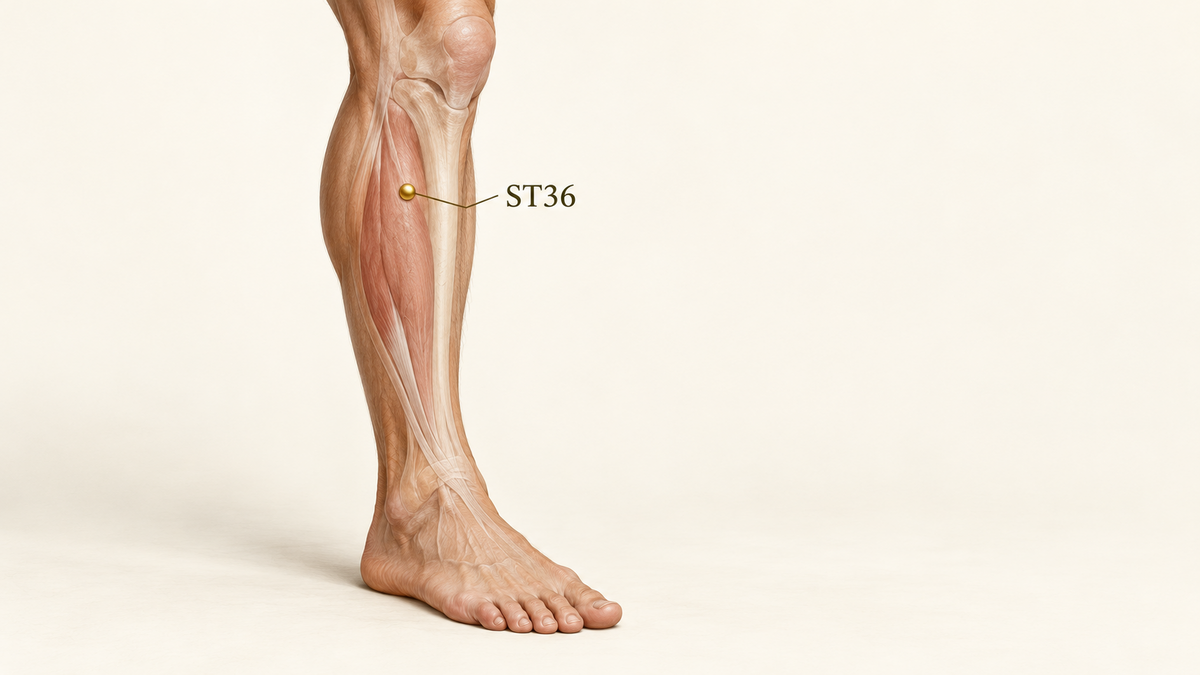
- ST36 is located on the outer-front portion of the lower leg, below the knee and just lateral to the tibial crest.
- In traditional Chinese medicine, it belongs to the Stomach channel and is commonly used for digestive symptoms, weakness, fatigue, pain, and broader regulation.
- From a modern anatomical perspective, the point lies over the tibialis anterior region near important sensory and motor nerve pathways.
- Research on ST36 is interesting, especially in electroacupuncture studies and it’s ability to affect the GI tract specifically.
- ST36 works best as part of an individualized point prescription, not as a universal recipe.
- Acupressure at the area may be reasonable for mild self-care, but self-needling is not appropriate.
Where is ST36 located?
ST36 is on the anterolateral lower leg. In standardized acupuncture location, it is three body-cun below ST35 near the knee and approximately one finger-breadth lateral to the front edge of the tibia. The point sits in the tibialis anterior region rather than directly on the shin bone.
Patients sometimes try to locate it by measuring a fixed number of inches below the kneecap. That can be misleading because acupuncture uses proportional body measurement, and leg size varies. A trained practitioner also palpates the local anatomy instead of relying on a diagram alone.
When the needle is placed correctly, the sensation may feel heavy, dull, warm, or mildly electric. A dramatic sensation is not required for the point to be useful, and stronger stimulation is not automatically better.
Why is ST36 used so often?
ST36 is versatile, accessible, and easy to combine with local or distant points. It can be used on its own side of the body, on both legs, manually, or with gentle electrical stimulation depending on the goal and the person’s tolerance.
It is also a useful example of how acupuncture prescriptions are built. I may choose it because of a digestive complaint, because someone feels depleted after a long illness, because the lower leg itself is involved, or because I want a distal point that complements treatment elsewhere in the body.
Different points play different roles, as I explain in GB20 for headaches and neck tension. That does not mean ST36 is always necessary. If the examination and treatment strategy point in another direction, I may not use it at all.
How I decide whether ST36 belongs in a treatment
I start with the problem, not the popularity of the point. If someone comes in with nausea, I want to know whether it is new or chronic, whether there is vomiting, abdominal pain, medication use, pregnancy, dehydration, migraine, or another medical explanation. If the complaint is fatigue, I want to know about sleep, anemia, thyroid function, infection, mood, nutrition, medication effects, and the person’s overall health.
With pain, the same rule applies. ST36 may support a broader acupuncture plan, but it does not replace examining the painful region, checking strength and sensation, or deciding whether imaging or referral is appropriate.
🩺 Clinical Insight
A commonly used point earns its place by fitting the case, not by appearing on a memorized list. When I use ST36, I should be able to explain what role it plays in that particular treatment and what I will watch for afterward.
What ST36 means in traditional Chinese medicine
ST36 is the He-Sea point of the Stomach channel. Traditionally, it is used to regulate the Stomach and Spleen systems, support qi and blood, strengthen weakness, and address a wide range of abdominal and digestive complaints.
The name Zusanli is often translated as “Leg Three Miles.” A common interpretation is that the point was valued for helping a tired person continue walking, although historical names are not always literal instructions.
In a traditional treatment, ST36 might be considered for poor appetite, nausea, loose stools, abdominal discomfort, fatigue, weakness, or recovery. Those categories describe a Chinese medicine pattern. They are not the same thing as a modern diagnosis, and they should not be used to explain away symptoms that need medical evaluation.
What might be happening anatomically?
ST36 lies over the tibialis anterior region near branches of the fibular, also called peroneal, nerve system. Needling or electrical stimulation in this area creates sensory input that travels through peripheral nerves into the spinal cord and brain. That input may influence pain processing, motor output, and autonomic regulation.
This is more useful than saying the point simply “boosts immunity” or “balances everything.” Acupuncture effects depend on location, depth, technique, stimulation intensity, the person’s nervous system, and the condition being treated.
It is also important not to flatten two medical systems into one. The traditional Stomach channel is not literally the deep fibular nerve. Traditional point functions and modern neuroanatomy can inform the same clinical conversation without being treated as identical maps.
What does the research say about ST36?
The research is promising in places, but it needs careful interpretation.
A widely discussed 2021 Nature study found that low-intensity electroacupuncture near ST36 activated a vagal-adrenal anti-inflammatory pathway in mice through a specific population of sensory neurons. The study helped demonstrate that stimulation location and intensity can matter. It did not show that manual needling at ST36 will treat systemic inflammation in every human patient.
A systematic review of 17 randomized trials reported that electroacupuncture at ST36 and/or PC6 was associated with faster postoperative gastrointestinal recovery and less postoperative nausea and vomiting.
Brain-imaging studies also show measurable responses to ST36 stimulation, but the studies are small and heterogeneous. A brain response is evidence that stimulation is being processed, not proof of a particular clinical benefit.
The practical conclusion is modest: ST36 is biologically active and worth studying, but the strongest clinical decisions still come from the whole diagnosis, the full point prescription, the treatment dose, and the patient’s response over time.
When might I use ST36 in the clinic?
Digestive symptoms
ST36 may be included for nausea, reduced appetite, abdominal discomfort, or bowel-pattern changes when acupuncture is appropriate. The rest of the treatment depends on the pattern, medical history, and whether the symptoms require conventional evaluation.
Fatigue or recovery
I may use it when someone feels depleted, is recovering from illness, or has a combination of fatigue and digestive weakness. But acupuncture should not become a substitute for evaluating persistent fatigue, unexplained weight change, shortness of breath, bleeding, infection, thyroid disease, sleep problems, or anemia.
Pain and nervous-system regulation
ST36 can function as a distal point in a pain treatment or be paired with local points, motor points, or electroacupuncture. The goal may be to change pain sensitivity, reduce guarding, or support a broader treatment rather than directly needle the most irritated area.
Lower-leg and knee treatment
Because of its location, ST36 may also be chosen when working with the tibialis anterior, knee, or lower-leg function. In that situation, anatomy and tissue irritability may matter more than the point’s traditional systemic uses.
Is ST36 a point you can use at home?
Gentle acupressure is reasonable for many adults. Find the muscular area on the outer-front lower leg below the knee, stay off the sharp edge of the tibia, and use comfortable pressure for 30 to 60 seconds while breathing normally. Repeat once or twice rather than pressing until the area is sore.
Do not press over a recent injury, suspected fracture, significant swelling, a skin infection, an open wound, or an area with impaired sensation. New calf swelling, warmth, redness, or shortness of breath needs medical attention rather than acupressure. Do not attempt to needle the point yourself.
Common misconceptions about ST36
“ST36 boosts the immune system.”
That claim is too broad. Preclinical research suggests that certain forms of electroacupuncture can influence neuroimmune pathways, but that is not the same as proving a universal immune boost in people.
“If ST36 is good for digestion, everyone with stomach symptoms should use it.”
Digestive symptoms have many causes. A point choice should not delay evaluation of persistent pain, bleeding, fever, dehydration, unexplained weight loss, or significant changes in bowel habits.
“The stronger the sensation, the better the treatment.”
No. Technique should match the goal and the person. More stimulation can be counterproductive in a sensitive, depleted, anxious, or acutely painful patient.
“One powerful point can replace a complete treatment.”
ST36 is usually one part of a prescription. Point combinations, technique, treatment frequency, lifestyle factors, and the underlying diagnosis all influence the result.
When I recommend further evaluation
Acupuncture is not the first step for every symptom associated with ST36. Seek prompt medical care for severe or worsening abdominal pain, persistent vomiting, vomiting blood, black or bloody stool, fainting, chest pain, marked dehydration, unexplained weight loss, new neurologic weakness, or a hot and swollen calf.
Persistent fatigue, appetite change, altered bowel habits, or recurrent nausea also deserves an appropriate medical workup. Acupuncture can be used alongside that process when it is safe and clinically sensible.
💡 Common Roots Clinical Pearl
The value of ST36 is not that it treats everything. Its value is that it can play several different roles, and a good treatment makes that role specific.
Practical next steps
If you are curious about ST36 because of digestion, pain, fatigue, or recovery, start with the symptom rather than the point. Keep track of when the problem occurs, what changes it, and whether there are warning signs that deserve medical evaluation.
During an acupuncture visit, the point may or may not be included. The treatment should reflect your history, examination, goals, and response, not a one-size-fits-all point formula.
At Common Roots Acupuncture in Tucson, I combine traditional point selection with modern anatomy and clinical reasoning. The goal is not to use the most famous points. It is to choose the smallest useful set of points for the person in front of me.
Frequently asked questions
Where is the ST36 acupuncture point?
ST36 is located on the outer-front portion of the lower leg, below the knee and just lateral to the tibial crest in the tibialis anterior region. Practitioners use proportional measurement and palpation rather than relying on a fixed number of inches.
What is ST36 traditionally used for?
In traditional Chinese medicine, ST36 is commonly used for digestive symptoms, nausea, fatigue, weakness, pain, and general support. Its role depends on the person’s pattern and the other points used with it.
Can I use acupressure on ST36 myself?
Many adults can try gentle pressure over the muscular area below the knee for 30 to 60 seconds. Avoid injured, infected, swollen, numb, or broken skin, and seek medical care for concerning symptoms.
Does ST36 hurt when needled?
People may feel a quick pinch followed by heaviness, warmth, dull aching, or a spreading sensation. Strong sensation is not required, and the stimulation should be adjusted to the patient.
References
World Health Organization: A Proposed Standard International Acupuncture Nomenclature
NCCIH: Acupuncture, Effectiveness and Safety
