
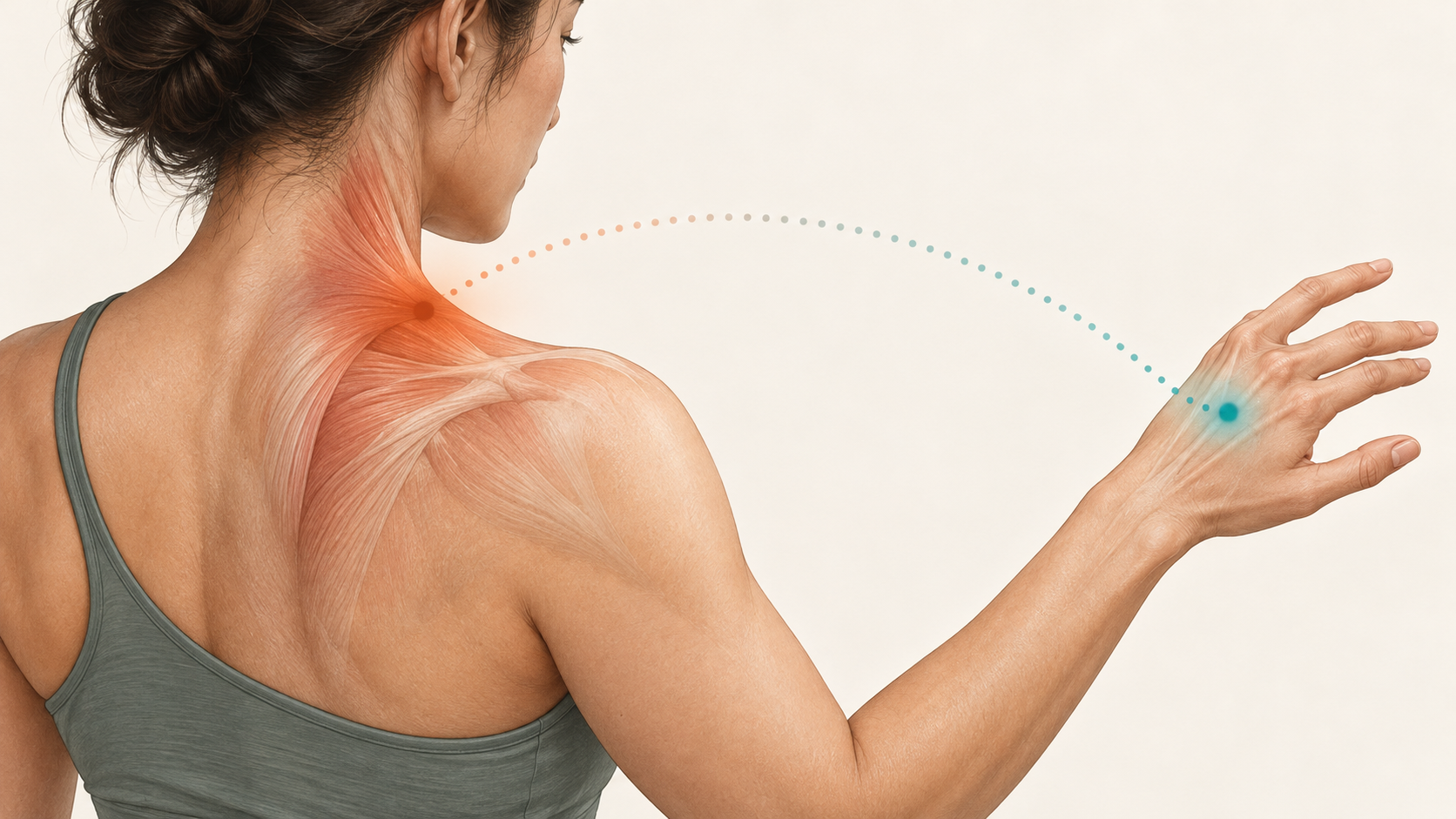
If your shoulder hurts, you probably expect the needles to go into your shoulder. Then I place a point in your hand or lower leg and you understandably ask, “What does that have to do with anything?”
It is one of the best questions patients ask me. Acupuncture does not always treat the exact spot that hurts, because pain location is only one piece of the problem. Sometimes a local point is the most useful choice. Sometimes a distant point changes the symptom more clearly. Most of the time, I use a combination and watch how the body responds.
Traditional Chinese medicine explains these relationships through channels connecting different regions of the body. Modern research uses a different vocabulary: sensory nerves, spinal and brain pain processing, connective tissue, motor control, and the broader context of treatment. Those explanations are not identical, and I do not pretend they are. Both can help us understand why a needle in the hand may affect a painful shoulder or head.
Key takeaways
- The place you feel pain is not always the only place influencing it. Referred pain, nerve sensitivity, muscle coordination, and the brain’s pain-processing systems can all widen the picture.
- Distal points are acupuncture points located away from the painful area. They may be chosen from a traditional channel relationship, a modern anatomical strategy, or both.
- Local and distant points are not rivals. Each can be useful, and many treatments combine them.
- A point should not be selected from an internet list alone. Diagnosis, symptom behavior, examination findings, safety, and response to treatment matter.
- Research supports several nervous-system and tissue effects of acupuncture, but it has not proven that every traditional point has one unique, predictable effect.
What is a distal acupuncture point?
A distal point is simply a point located away from the main symptom. LI4, in the web of the hand between the thumb and index finger, is a familiar example. It is traditionally used for problems involving the face and head even though it is nowhere near the jaw, temple, or forehead.
“Distal” does not mean random. A point may be chosen because it belongs to a channel associated with the painful region, because it provides a useful sensory input to the nervous system, because the local area is too irritable to needle, or because it changes a movement or symptom during the visit.
| Approach | What it targets | When it may be useful |
| Local points | Tissue at or near the symptom | A clearly involved muscle, tendon region, joint line, trigger point, or local sensitivity pattern |
| Distal points | A point away from the symptom | A channel relationship, broader pain modulation, a very sensitive local area, or a point that changes movement |
| Combined plan | Local tissue plus the larger pattern | Persistent or complex symptoms, mixed local and nerve-related findings, or when either strategy alone is incomplete |
Why the painful spot is not always the whole story
Pain is real, but it is not a perfect map of tissue damage. A trigger point in the neck can refer pain behind the eye. A cervical nerve can create symptoms in the shoulder or hand. A sensitive tendon can hurt at a site that looks normal on imaging. The nervous system continuously interprets signals from tissues, movement, sleep, stress, previous injury, and perceived threat.
That is why chasing the loudest spot is not always enough. If someone comes into my Tucson clinic with shoulder pain, I still examine the shoulder. But I may also check the neck, shoulder blade, grip, breathing pattern, and the movements that bring the pain on. A distant point becomes more convincing when it changes something meaningful, such as the painful arc, neck rotation, or the intensity and spread of symptoms.
🩺 Clinical Insight
The point is not the diagnosis. Tenderness at LI4 does not prove a headache is coming from LI4, just as a sore upper trapezius does not prove the trapezius is the entire problem. A useful point earns its place by fitting the pattern and helping the patient move or feel better.
The traditional Chinese medicine explanation
Traditional acupuncture organizes the body through channels, sometimes called meridians. These channels describe functional relationships among regions. For example, the Large Intestine channel travels from the hand toward the face, which is one reason LI4 has long been used for headaches, tooth pain, jaw tension, and facial discomfort.
I find this framework clinically useful, but I do not describe a channel as a hollow tube that scientists simply have not found yet. It is a traditional map built from observation and repeated clinical use. The map helps an acupuncturist choose and combine points. Modern anatomy helps us ask different questions about nerves, muscles, connective tissue, and safety.
The two systems overlap in places, but they are not interchangeable. Saying that a meridian is “just a nerve” oversimplifies Chinese medicine. Saying that modern physiology has proven every classical claim oversimplifies the research.
The modern physiology explanation
A needle provides a small, controlled sensory input. That input is detected by receptors in the skin, connective tissue, and muscle and carried into the nervous system. Depending on the location, depth, technique, and person, acupuncture may influence local tissue responses as well as spinal and brain networks involved in pain modulation.
Researchers have described several possible mechanisms, including changes in sensory signaling, activation of descending pain-control systems, release of endogenous pain-modulating chemicals, and effects on connective tissue and local circulation. Context also matters. Expectations, attention, the therapeutic relationship, and the sense of safety created during care can contribute to symptom change. That is not a reason to dismiss the treatment. It is a reason to be honest that acupuncture, like many hands-on treatments, is not one isolated mechanism.
A distant point can therefore matter without being physically connected to the painful spot by one special wire. The nervous system is a network. Stimulating one region can change how another region is processed, much like rubbing your shin after bumping it can temporarily change the pain even though the rubbing did not repair the bruise.
🩺 Clinical Insight
Research has found that both local and distant acupuncture can reduce pain in some musculoskeletal studies. It has not established a universal winner. The better question is which combination fits this patient, this condition, and this stage of recovery.
How I decide which points to use
I do not start with a point list. I start with the person and the behavior of the problem.
- First, I clarify what may be happening. Is this primarily muscular, joint-related, tendon-related, nerve-related, headache-related, systemic, or a mixture? Are there signs that require imaging or medical referral?
- Next, I examine the local area when appropriate. I look at motion, strength, tenderness, sensory changes, and which tasks reproduce the symptom.
- Then I choose a working strategy. That may include local tissue points, distal channel points, motor points, electroacupuncture, or a limited combination.
- Finally, I reassess something meaningful. Did the painful movement change? Is the range smoother? Did the symptom become less intense or less widespread? A response does not prove a diagnosis, but it helps guide the session.
This is where experience matters. Two people can both report shoulder pain and receive different points because one has an irritable rotator cuff, another has neck-related referral, and a third has a broader tension and sleep pattern that keeps amplifying the problem.
Why not just needle the painful area?
Sometimes I do. Local needling can be very useful when the examination identifies a relevant muscle, motor point, trigger point, or painful tissue region. But more local treatment is not automatically better.
A painful area may be too sensitive during an acute flare. It may be swollen, recently injured, difficult to position, or unsafe to needle directly. The symptom may also be referred from somewhere else. In those situations, distal points let me begin treatment without repeatedly provoking the most reactive tissue.
🩺 Clinical Insight
I am cautious about turning every painful spot into a target. If needling the sore area makes someone guard more and move less, I may start farther away, calm the system down, and return to the local tissue later if it is still useful.
What the research says
The research supports a measured answer rather than a dramatic one. The National Center for Complementary and Integrative Health notes that acupuncture may affect nervous-system function and local tissues, while nonspecific factors also contribute. Evidence suggests benefit for several pain conditions, but results vary by diagnosis, study design, and comparison group.
A 2015 systematic review comparing local and distant point stimulation for chronic musculoskeletal pain found that both approaches reduced pain compared with their controls immediately after treatment. It did not show a clear overall advantage for combining them, and the included studies were not uniform. Mechanism reviews describe effects on peripheral signaling and descending pain-control systems, but much of that literature cannot tell us that one named point will create one guaranteed clinical effect.
That uncertainty fits the way I practice. Traditional point knowledge gives me a strong starting map. The examination, the patient’s response, and the best available evidence keep the map grounded.
Common misconceptions
“A distant point means the practitioner is ignoring the painful area.”
Not necessarily. A good evaluation still examines the painful region and screens for problems that need other care. The distant point is one treatment choice, not a substitute for diagnosis.
“Every acupuncture point has one proven function.”
Traditional texts give points characteristic actions, but real treatment is more contextual. Technique, combinations, diagnosis, dose, and the person receiving care all matter.
“If the point helps immediately, it proves the cause.”
An immediate change is useful, but it does not prove that the point corrected one exact lesion. Pain and movement can change through several mechanisms. We still need to watch what happens over time and with normal activity.
“Distal acupuncture should replace exercise or medical evaluation.”
No. Acupuncture may make movement and recovery easier, but persistent weakness, progressive numbness, significant trauma, systemic illness, or other warning signs require the appropriate evaluation. Many orthopedic problems also need progressive loading and movement work.
Can you try a distal point at home?
For a mild, familiar headache or jaw-tension pattern, gentle acupressure at LI4 can be a reasonable self-care experiment. Press the web of the opposite hand between the thumb and index finger with steady, comfortable pressure for 30 to 60 seconds while breathing normally. Stop if it increases pain, causes numbness, or feels unpleasant.
Acupressure is not a substitute for dental care, migraine evaluation, or assessment of a new or severe headache. If you are pregnant, ask a qualified clinician before using strong or prolonged LI4 stimulation.
When I recommend further evaluation
The fact that acupuncture can use distant points does not mean every symptom should be treated as a channel imbalance. Seek prompt medical evaluation for sudden severe headache, chest pressure or shortness of breath, new facial droop, new weakness, progressive numbness, loss of coordination, bowel or bladder changes, fever with severe pain, unexplained weight loss, major trauma, or pain that is rapidly worsening.
For less urgent problems, an evaluation makes sense when symptoms persist, repeatedly return, limit normal activity, disturb sleep, or stop responding to the strategies that used to help. The treatment plan is better when the diagnosis and the limits of conservative care are clear.
Frequently asked questions
Why would an acupuncturist use a hand point for a headache?
In traditional Chinese medicine, points on the Large Intestine channel, including LI4, have a long-standing relationship with the face and head. From a modern perspective, stimulation in the hand also provides sensory input that may influence pain-processing networks. It can be useful, but it does not replace evaluation of a new, severe, or unusual headache.
Are distal points better than local points?
Not across the board. Research suggests both can help in some musculoskeletal pain conditions. I choose based on the diagnosis, tissue sensitivity, symptom pattern, and what changes during treatment.
Do meridians follow nerves?
Some channel pathways overlap with known nerves, muscles, and connective-tissue planes, but meridians are not simply another name for nerves. They are a traditional functional map. Modern neuroanatomy and traditional channel theory answer different questions.
How quickly should a point change the pain?
Sometimes a movement changes during the visit. Other times the change is gradual over several sessions. No immediate response does not automatically mean the treatment cannot help, and an immediate response does not guarantee a lasting result.
Can one point treat many unrelated conditions?
A point can appear in many treatment plans because it may contribute a useful function within different combinations. That does not make it a cure-all. The diagnosis and the rest of the plan still matter.
💡 Common Roots Clinical Pearl
Where the needle goes and where the problem is are related questions, but they are not always the same question. The best point is the one that fits the pattern, is safe to use, and helps create a meaningful change.
Practical next steps
If you are curious why a certain point was chosen, ask. A good acupuncturist should be able to explain the reasoning in plain language without pretending that every mechanism is settled science.
If your pain is persistent or keeps returning, start with a careful evaluation rather than trying to assemble a treatment from point charts online. At Common Roots Acupuncture in Tucson, I combine traditional point selection with orthopedic examination, modern anatomy, and ongoing reassessment. The goal is not to put needles in as many places as possible. It is to choose the smallest useful plan and adjust it based on how you respond.
Learn what to expect at your first visit.
