
You wake up with a tight jaw, a dull ache at the temples, and a neck that already feels tired before the day has started. Or maybe the pattern builds while you work: your shoulders rise, your teeth touch, and by late afternoon the tension has traveled from your jaw into your head and upper neck.
Teeth grinding and jaw clenching can contribute to this pattern. But the important word is contribute. Bruxism is not the only reason people develop neck pain or headaches, and tenderness around the jaw does not prove that the jaw is the whole problem. The useful question is how the jaw, neck, sleep, stress, and headache pattern interact in your particular case.
Key takeaways
- Bruxism is repetitive jaw-muscle activity that can happen while awake or asleep.
- Clenching or grinding may fatigue the chewing muscles and can be associated with jaw pain, temple headaches, facial pain, and neck symptoms.
- Bruxism, temporomandibular disorders (TMDs), migraine, and neck-related headache can overlap. One does not automatically explain the others.
- A mouth guard can help protect the teeth, but it does not necessarily stop the nervous system from producing bruxism.
- Treatment works best when it matches the pattern and includes dental or medical evaluation when needed.
What bruxism actually means
Bruxism is the term used for grinding, clenching, or bracing the jaw. It can occur during sleep or while you are awake. Awake bruxism often looks less dramatic than people expect. You may not hear grinding at all. Instead, you may hold the teeth together, brace the jaw during concentration, or tense the chewing muscles without noticing.
Sleep bruxism is different. It occurs during sleep and is linked to sleep-related jaw-muscle activity. A partner may hear grinding, but many people first notice indirect clues: tooth wear, a tired jaw in the morning, tooth sensitivity, or a morning headache.
Current research increasingly treats bruxism as a behavior or muscle-activity pattern rather than automatically labeling it a disease. Mild bruxism may not require treatment. It becomes clinically important when it damages teeth, aggravates pain, disrupts function, or appears alongside a sleep or neurologic concern.
How the jaw can affect the temples, head, and neck
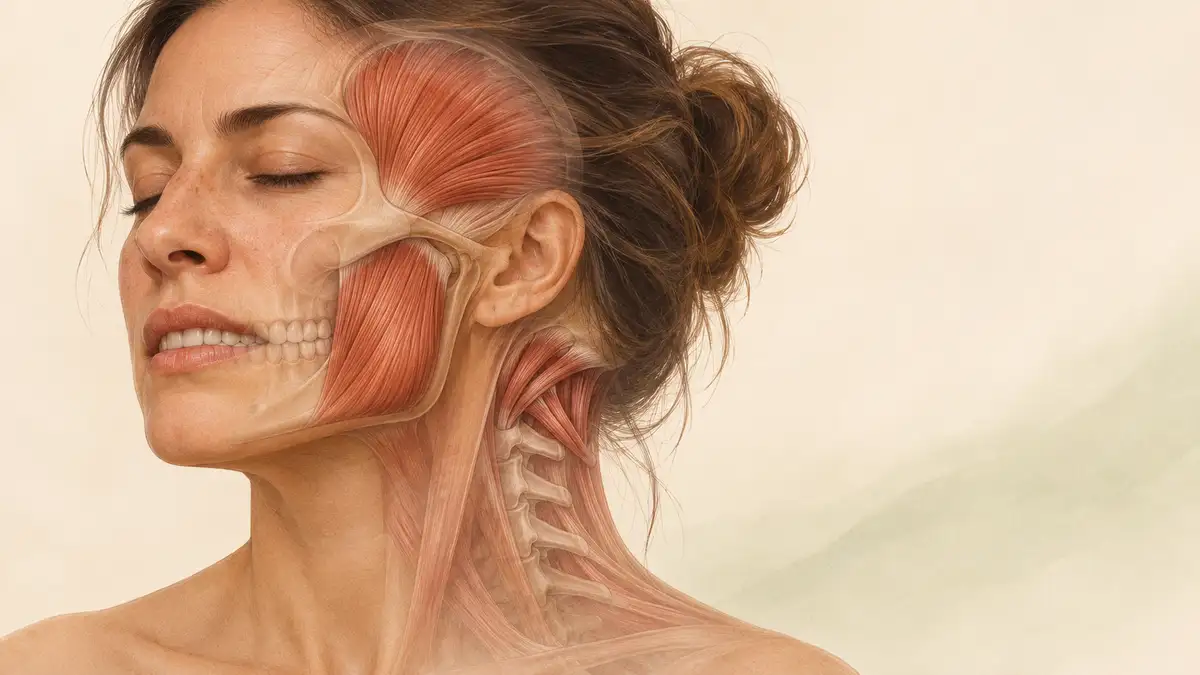
The jaw does not work in isolation. The masseter at the side of the jaw and the temporalis at the temple are major chewing muscles. Deeper muscles guide the jaw joint, while muscles under the chin and along the front and back of the neck help coordinate head position, swallowing, and jaw movement.
When these tissues repeatedly brace, several things can happen:
- The masseter and temporalis may become sore or fatigued.
- Pain can be felt locally in the jaw or referred into the temple, ear region, face, or teeth.
- The upper neck may stiffen as the head and jaw muscles co-contract.
- A sensitive jaw system can add another source of input to an already irritable headache system.
The sensory pathways of the face and upper neck also communicate closely. Trigeminal pathways carry sensation from the face and jaw, while upper cervical nerves carry sensation from the back of the head and neck. Those signals converge in the brainstem. This helps explain why jaw, temple, headache, and neck symptoms can overlap, even when no single muscle is solely responsible.
Clinical insight: Timing often gives us the best first clue. Symptoms that are strongest on waking raise different questions than symptoms that build during computer work, driving, or concentration. Morning symptoms make dental wear, sleep bruxism, sleep quality, and possible sleep-disordered breathing more relevant. Daytime buildup makes jaw awareness, posture, workload, and awake clenching more important.
Does teeth grinding cause headaches?
Sometimes it appears to play a meaningful role, especially when headache occurs with jaw-muscle pain or a temporomandibular disorder. But research does not support a simple rule that bruxism always causes headaches.
A 2024 review in Pain found that bruxism, TMDs, and headache commonly occur together, while the causal relationships remain uncertain. Bruxism itself is not necessarily a painful disorder. When it occurs with a painful TMD, however, it may worsen an existing headache pattern. Sleep and awake bruxism also need to be considered separately because they may influence headache differently.
This matters clinically. If someone has a temple headache, jaw fatigue, tooth wear, and pain with chewing, the jaw deserves attention. If the person also has light sensitivity, nausea, visual symptoms, or attacks that are not related to jaw use, migraine or another headache disorder may be the larger driver. Treating only the sore jaw muscles would miss part of the picture.
How to tell which pattern may be present
| Pattern | Clues that may point this way | What changes the plan |
|---|---|---|
| Bruxism or muscle-related TMD | Jaw fatigue, morning tightness, tooth wear, temple soreness, pain with chewing, daytime clenching | Dental exam, jaw-muscle assessment, habit awareness, conservative care |
| Migraine | Throbbing or disabling attacks, light or sound sensitivity, nausea, activity aggravation, possible aura | Headache-specific medical assessment and treatment; jaw treatment may be supportive but not sufficient |
| Neck-related headache | Pain influenced by neck movement or posture, reduced neck motion, pain beginning near the upper neck | Examine cervical movement, load tolerance, sleep position, and upper-neck tissues |
| Dental source | Focal tooth pain, temperature sensitivity, pain with biting, swelling, cracked or damaged tooth | Prompt dental evaluation |
| Needs urgent evaluation | Sudden severe headache, new neurologic symptoms, facial weakness, fever with swelling, trauma, vision loss, or rapidly changing symptoms | Urgent medical or dental care rather than routine musculoskeletal treatment |
Why people clench or grind
There is rarely one universal cause. Stress and sustained concentration can increase awake clenching. Sleep bruxism is related to sleep physiology and arousals rather than simply being a bad daytime habit that continues overnight. Alcohol, caffeine, nicotine, and some medications may increase bruxism in some people.
Snoring, witnessed pauses in breathing, gasping during sleep, marked daytime sleepiness, or unrefreshing sleep deserve attention. Those features do not prove sleep apnea, but they are reasons to discuss sleep evaluation with a qualified medical provider. A night guard should not become a substitute for investigating a possible sleep disorder.
It is also worth correcting a common assumption: a “bad bite” is not considered a routine explanation for TMD. The National Institute of Dental and Craniofacial Research notes that research does not support the belief that an abnormal bite or orthodontic treatment causes TMDs. Permanent bite-changing procedures should not be the first step for a pain pattern that has not been carefully evaluated.
What usually helps
1. Protect the teeth when protection is needed
If there is tooth wear, cracking, sensitivity, or damage, start with a dentist. A properly selected intraoral appliance can separate and protect the teeth. It may reduce symptoms for some people, but evidence for TMD pain relief is limited, and an appliance does not necessarily eliminate the underlying jaw-muscle activity. If a guard increases pain or changes how the bite feels, contact the prescribing dentist.
2. Reduce awake jaw bracing
For daytime clenching, awareness is often more useful than trying to “stretch harder.” At rest, the lips can be lightly together while the teeth remain apart. A phone reminder, a note near the computer, or a cue tied to routine tasks can help you notice whether you are pressing the teeth together.
Also look at the context. Do you clench while answering email, driving, lifting, or dealing with stressful conversations? That does not mean the pain is imaginary or “just stress.” It gives you a practical place to interrupt the muscle activity.
3. Address the neck and shoulders when they are part of the pattern
If neck position, rotation, sustained screen posture, or shoulder tension changes the headache, the examination should include the cervical spine and shoulder girdle. Treatment may include mobility work, progressive strengthening, breaks from sustained positions, and strategies to reduce unnecessary muscle guarding.
4. Use conservative treatment before irreversible procedures
Many TMD symptoms improve with simple, reversible care. Heat or cold, temporarily reducing very chewy foods, gentle movement, and reducing habits such as gum chewing may help during a flare. Aggressive jaw manipulation, permanent bite changes, or surgery should not be routine first-line care.
5. Consider acupuncture as one part of the plan
Acupuncture may be useful when the presentation includes painful or overactive jaw, temple, neck, and shoulder muscles. Treatment can be directed at the tissues that reproduce the familiar pain while also addressing the broader headache and neck pattern.
The evidence needs to be described honestly. A 2024 systematic review found that acupuncture may provide short-term benefit for muscle-related TMD pain, but the authors also concluded that the overall evidence remains limited and that better trials are needed. Acupuncture should not be presented as a way to repair damaged teeth, stop all sleep bruxism, or replace a dental or medical evaluation.
At Common Roots Acupuncture, that usually means deciding whether the jaw is the main driver, one contributor, or simply another sensitive area. Depending on the examination, treatment may include the masseter, temporalis, upper neck, shoulders, or other acupuncture points. The goal is to reduce pain and muscle guarding while making sure the plan also addresses tooth protection, sleep concerns, or migraine care when those are relevant. If neck and shoulder muscle tension is part of your pattern, you can also read about how we use dry needling in Tucson.
Three misconceptions worth clearing up
- “If my jaw clicks, I have a serious TMJ problem.” Painless clicking is common and often does not need treatment. Pain, locking, limited opening, or loss of function changes the picture.
- “A night guard will stop me from grinding.” A guard can protect teeth and may help symptoms, but it does not reliably switch off the nervous-system activity that produces bruxism.
- “If the jaw is tender, it must be causing the headache.” Tenderness shows that the area is sensitive. Migraine, neck pain, dental problems, and TMD can overlap, so the whole pattern matters.
When to get further evaluation
Arrange a dental evaluation if you have tooth damage, new sensitivity, pain with biting, a change in how the teeth fit together, or significant jaw locking. Talk with a medical provider about possible sleep evaluation if grinding occurs with loud snoring, gasping, witnessed breathing pauses, or excessive daytime sleepiness.
Seek urgent medical care for a sudden “worst” headache, new weakness or numbness, facial droop, confusion, fainting, loss of vision, fever with significant facial swelling, severe symptoms after trauma, or a rapidly worsening pattern. A new headache after age 50, a major change from your usual headaches, or a headache associated with exertion also deserves timely medical evaluation.
Common Roots clinical pearl: Do not chase the sorest spot without asking when and why it becomes sore. A morning jaw-and-headache pattern, a workday clenching pattern, and a migraine with jaw sensitivity can all feel similar to the patient, but they call for different priorities.
A practical next step
If your jaw, neck, and headaches keep showing up together, start by tracking the timing for one week. Note whether symptoms are present on waking, build during concentration, change with chewing, or come with migraine features such as nausea or light sensitivity. That short record can make a dental, medical, or musculoskeletal evaluation much more useful.
If the pattern appears to involve jaw and neck muscle tension, TMJ treatment, neck pain care, and acupuncture may be reasonable parts of a conservative plan. If you are waking with stiffness, our guide to morning neck pain may also help you sort out the clues.
Frequently asked questions
Can clenching your jaw cause neck pain?
It can contribute. The chewing muscles, jaw joint, and neck muscles work as a coordinated system. Repeated jaw bracing may increase muscle fatigue and guarding in the upper neck, but neck pain can also have other causes that need to be examined.
What does a bruxism headache feel like?
People often describe pressure or aching in the temples, forehead, face, or around the jaw, sometimes with morning jaw fatigue. That pattern is not unique to bruxism, so migraine, TMD, dental problems, and neck-related headache still need to be considered.
Will a night guard stop headaches?
A night guard may protect the teeth and may help some people, but it does not reliably stop bruxism or every type of headache. If headaches continue, the diagnosis and the rest of the treatment plan should be reassessed.
Can acupuncture help jaw clenching?
Acupuncture may help reduce short-term pain and muscle tension in some people with muscle-related TMD. Evidence is still limited, and acupuncture does not replace dental care for tooth damage or medical evaluation for concerning headache or sleep symptoms.
Should I see a dentist or an acupuncturist first?
See a dentist promptly if you have tooth damage, focal tooth pain, new bite changes, or jaw locking. When the main issue is a recurring muscle-tension pattern involving the jaw, neck, and head, acupuncture may be included alongside appropriate dental or medical care.
